具有发送与接收证明的沟通
电子通知
在Lleida.net,您只需支付所消费的费用,我们没有订阅或订阅费用,并且购买永不过期
就像发邮件那么简单
签署文件与合同
我们的分部 国际化
Lleida
Madrid
Paris
London
Miami
Dubai
San José
Bogotá
São Paulo
Tokyo
Santo Domingo
Cape Town
Johannesburg
Montevideo
Santiago de Chile
Lima
Beirut
Ciudad de México

对于我们的服务满意的客户
成功案例
We particularly loved the ease and agility of contracting the system and its credit-based use. In other words, you top up some credits and start working without too much training, without any specific software installation or technical complexity
Registered notification service has made possible to help in the internal operating processes of companies and in their digital transformation.
Lleida.net gives us peace of mind and guarantees that parents verify the engagement of our services in a simple safely and legally way.
Connectaclick Pro允许HolaLuz为客户提供量身定制的解决方案,成为我们 必要 纳入所有流程的必备服务。
感谢本协定,允许我们为用户提供安全,可信和高效率的服务,为其提供最高质量的沟通与关注。











新闻,教程,访谈等
Blog
 2 十月, 2026
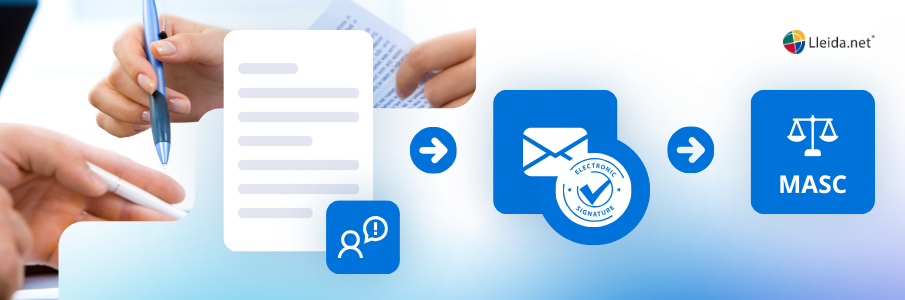
Spanish Mortgage Claim: How to Prove You Sent Your Prior Claim to the Bank
If you bought a property with a mortgage in Spain, there is a new rule you need to know before taking your bank to court. To move forward with a Spanish mortgage claim, you must be able to prove that you first sent a written claim to the bank. That proof has to show three things: what you sent (the text and any attachments), when you sent it (date and time) and what reached the recipient.
For a Spanish mortgage claim,a standard email or a web form does not guarantee this. A Registered email or a burofax does. And this is no minor detail: since Organic Law 1/2025 (Ley Orgánica 1/2025) came into force, if you sue over an unfair clause in your mortgage without proving that prior claim, the court may refuse to admit your case.
Why this matters if you bought a property in Spain from abroad
Thousands of British and other European buyers have taken out mortgages in Spain to buy a holiday home, a retirement property, or a home for a future move. Spanish consumer protection law applies to them in the same way as it does to Spanish residents: if you signed the loan as a private individual, not for business purposes, you are treated as a consumer.
That means you can benefit from the Spanish Supreme Court’s rulings on unfair mortgage clauses. It also means you are bound by the same procedural rules, including the obligation to claim from the bank first. The good news is that you do not need to travel to Spain to do it: a Spanish mortgage claim can be sent by email from anywhere.
A recent example: single-premium life insurance
On 11 June 2026, the Spanish Supreme Court (Judgment No. 913/2026 – ECLI:ES:TS:2026:2627) ruled that it is unfair for a bank to require a customer to take out single-premium life insurance, financed through the mortgage itself and arranged with an insurer from the bank’s own group, without letting the customer choose another insurer or pay periodic premiums. According to the Supreme Court, the cost of that premium should also have been included in the APR (known in Spain as the TAE).
In the case decided, the premium was almost €24,500 on a mortgage of around €151,500: more than 16% of the capital. If you took out a mortgage in Spain on similar terms, you may be able to recover the unused part of the premium and the interest you have paid to finance it.
But before thinking about court, the law requires you to take a first step: send a Spanish mortgage claim to the bank in writing, and be able to prove it.
Is a prior Spanish mortgage claim compulsory before going to court?
Claiming from the bank before going to court is nothing new. Spanish banks have had customer service departments for more than twenty years. In 2017, an out-of-court procedure was also created for floor clauses, but it was voluntary: you did not need to use it to sue.
What changes with Organic Law 1/2025 on the efficiency of the Public Justice Service is that the claim is no longer optional. Since 3 April 2025, Article 439.5 of the Spanish Civil Procedure Act (Ley de Enjuiciamiento Civil, or LEC) states that lawsuits to recover amounts paid under unfair clauses in mortgage loans will not be admitted unless they include a document proving the prior claim to the bank.
In other words: if you cannot prove your Spanish mortgage claim, your case may never get past the front door.
How the out-of-court Spanish mortgage claim procedure works (Article 439 bis LEC)
For consumer claims against financial institutions over unfair clauses, Article 439 bis LEC sets out a specific procedure:
- How it starts: you send your Spanish mortgage claim to the financial institution that granted your loan.
- The bank’s response: the bank must either accept or reject it.
- If it accepts, it must provide you with a breakdown of the amount to be refunded, including interest. If you accept, the bank must also acknowledge that the clause is null and void.
- If it rejects, it must give reasons for its decision.
- Your decision: you must accept or reject the bank’s proposal.
- Deadlines: see the table below.
- End without agreement: the procedure ends if the bank expressly rejects the claim, if a month passes without a reply, or if you disagree with the calculation, the amount offered or the bank’s position on the nullity of the clause.
| Stage | Deadline |
| Agreement between the consumer and the bank | 1 month from submission of the claim |
| Payment after accepting the offer | 1 further month from the consumer’s acceptance of the offer. If the bank does not pay, the late-payment interest rate rises by 8 percentage points, and you can go to court |
The procedure is free of charge, and while it is underway, neither party can take legal action on the same matter. There is one more key point: the positions you and the bank take during this stage may later be considered by the court when deciding who pays the legal costs. That is why being able to prove exactly what your Spanish mortgage claim said, and on what grounds, matters so much.
What evidence proves your Spanish mortgage claim?
This is where many a Spanish mortgage claim falls down. Not every communication channel leaves the same record:
| Channel | Proves content | Proves date and time | Proves delivery |
| Standard email | Partially | Partially | No |
| Ordinary letter | No | No | No |
| Burofax with text certification | Yes | Yes | Yes |
| Lleida.net Registered email | Yes, including attachments | Yes | Yes, to the recipient’s mail server |
Why send your Spanish mortgage claim by Registered email?
The prior claim is addressed to the bank’s customer service department (Servicio de Atención al Cliente, or SAC), and most banks have a dedicated email address for it. You do not need to visit a branch or send a paper burofax, which is especially useful if you are not based in Spain.
Lleida.net Registered email generates an evidence certificate that proves the sending, the exact content, the attachments, the date and time, and delivery to the recipient’s mail server. That way, you can show what you claimed, when and on what grounds, without relying on the bank to confirm it.
Lleida.net is a trust service provider under the European eIDAS Regulation (EU) No 910/2014. Under this regulation, evidence cannot be denied legal effect in court solely because it is in electronic form.
Timing matters too. In single-premium insurance cases, the Supreme Court calculates the part of the premium already used up until the judgment becomes final. The sooner you claim, the sooner the procedure starts running.
How to send your Spanish mortgage claim with Lleida.net: 4 steps
- Write your Spanish mortgage claim in your usual email client. Identify the loan (number and date of the mortgage deed, or escritura), explain which clause you are claiming and what you are asking for. Tip: Spanish banks generally handle claims in Spanish, so writing in Spanish or attaching a translation can help avoid delays.
- Address it to your bank’s SAC email and attach the documents: your ID (passport, NIE or DNI), the mortgage deed, the FEIN (European Standardised Information Sheet) or binding offer and, if you are claiming over insurance, the policy.
- Add Lleida.net’s certifying address in the copy (CC). Before sending, check that your email address is on the whitelist in your Lleida.net account. You can follow a step-by-step tutorial for sending a Registered email here.
- Keep the evidence certificate you receive. It is your proof that your Spanish mortgage claim was sent, and of its content, and the document you will attach to your lawsuit if you go to court.
What if the bank replies to or rejects your Spanish mortgage claim?
If the bank accepts your Spanish mortgage claim, you will receive its proposed calculation and can choose whether to accept it. If it rejects the claim or fails to reply within one month, the out-of-court attempt is complete and documented. From there, you can file a complaint with the Bank of Spain (Banco de España) or consider legal action. In every case, your certificate proves that you claimed it and when.
Frequently asked questions about Spanish mortgage claims
Does the bank’s web form count as proof?
Do Spanish courts accept certified email as proof of a prior Spanish mortgage claim?
Which address should I send the claim to?
What do I do with the certificate if I end up suing?
What if the bank says the certificate is not valid?
This article is for general guidance only and isn't legal advice. Every mortgage is different, so it's worth speaking to a qualified lawyer before you make a claim.
 30 九月, 2026
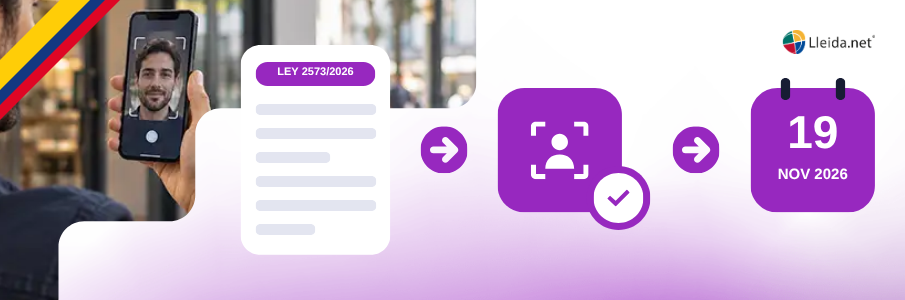
Law 2573 of 2026: What Companies Doing Business in Colombia Must Prove by 19 November
If you do business in Colombia, in telecoms, banking, fintech or any business that sells on credit, a new law changes what you must be able to show about your customers.
The numbers explain why. Between 2022 and May 2026, Colombia's Superintendence of Industry and Commerce (SIC), the authority responsible for consumer and personal data protection, recorded 13,983 formal complaints of identity theft. 81% of them involved the telecom sector. Congress responded with Law 2573 of 2026, an unprecedented regulatory change that requires banks and telecom operators to overhaul their digital onboarding and how they manage customer documentation.
The deadline is 19 November 2026, when the law's general regime takes effect. From then on, verifying a customer's identity is not enough. You have to prove it, with documentary and digital evidence that the applicant was properly authenticated.
What is Colombia's Law 2573 of 2026?
Law 2573 of 2026 is a statutory law enacted on 19 May 2026 to protect victims of identity theft and financial fraud: stolen personal data, credit opened fraudulently in someone's name and online scams.
Its core purpose is to stop victims from being chased for payment or reported to Colombia's credit bureaus for debts they never took on.
Does Law 2573 apply to your business in Colombia?
The law is mandatory nationwide. If your company operates in Colombia in any of these three sectors, it is directly affected:
- Telecom operators, who activate lines and services in a person's name.
- Financial and credit institutions: banks, financing companies, cooperatives engaged in financial activities, fintechs, and any other entity that grants credit.
- Businesses that offer credit to their customers: in practice, any company that sells in instalments or finances purchases directly, such as car dealerships, e-commerce stores with in-house financing or even appliance retailers.
What changes: companies now carry the burden of proof
Identity theft is a common form of fraud in Colombia. Victims often only find out when a collection demand arrives, or a credit bureau reports them for a service they never requested. Until now, it was up to them to prove, through long legal proceedings, that they never signed the contract, while companies could take months to investigate and respond.
Law 2573 turns this around. It applies what Colombian law calls the dynamic burden of proof: the party best placed to prove a fact must prove it. In an identity theft case, the company is the one that received the documents and approved the product. That is why the law requires it to give the impersonated person a copy of the approval file, with no right to refuse, and to stop collection as soon as it is notified.
If the company is found to have breached the security protocols issued by the authorities, it must stop collection, correct the credit bureau report and either refund the money or cancel the debt. And if it misses the legal deadline to answer a complaint, positive administrative silence applies: the complaint is automatically resolved in the customer's favour.
What evidence you need under Law 2573, stage by stage
Holding data on your customers is not enough under Law 2573. You must be able to demonstrate how you verified their identity. As we explain in our article on why evidence has become the most valuable asset, a record only counts if it is intact, has a registered date and can be attributed to a specific person. This is what that means across the customer journey:
Customer onboarding and identity verification (KYC)
The law requires sufficient and reasonable digital security measures to establish that people are who they claim to be, and that their documents are genuine. That is the role of document validation, biometric authentication and remote video identification , which verify the person in real time and record the entire process.
A selfie or a photo of the cédula, Colombia's national ID card, is not enough on its own. That capture must be linked to the contract, carry a registered date and time, and be protected against any later alteration.
Contracting: electronic and digital signatures in Colombia
At the contracting stage, what matters is the type of signature and how it is linked to the signer. A registered digital signature with a timestamp, issued by a digital certification entity (ECD) accredited by ONAC, proves what was signed, when, and with what integrity guarantees. ONAC is Colombia's national accreditation body, and ECDs are the certification providers it accredits.
This rests on Colombian law: Law 527 of 1999 and Decree 2364 of 2012 (now compiled in Single Decree 1074 of 2015) recognise electronic signatures as valid when they are reliable and appropriate for the circumstances.
Complaint handling
Once someone reports possible identity theft, the legal deadlines begin to run. Registered SMS, email and WhatsApp notifications let you prove that each communication was sent and delivered, and what it said.
Handing over the approval file
If the person who was allegedly impersonated asks for it, the law requires you to hand over the documents and information used to approve the product or service requested in their name. A registered record of that handover can become strong evidence in criminal proceedings.
How Lleida.net helps you comply with Law 2573
Lleida.net operates in Colombia as a digital certification entity accredited by ONAC . Its digital trust services cover, with a single provider, every stage where Law 2573 of 2026 requires proof:
- Identity validation (eKYC Video): remote video identification that checks data against the National Identification Archive (ANI), the biographic and biometric database managed by Colombia's National Civil Registry (RNEC).
- Two-factor authentication (2FA) via Registered SMS, Registered email or digital certificate. It provides registered proof of both sending and code validation, and with a digital certificate you can also tie access to a verified identity, strengthening your verification and traceability processes.
- Contracting with a registered electronic signature and a digital signature, to prove who signed and what they signed.
- Timestamping to provide a registered date for every piece of evidence during onboarding or when issuing electronic files.
- Registered email and SMS, to prove that deadlines were met and communications sent on time. Registered WhatsApp notifications are also available.
- BPM platform: build your own robust process management platform, with full traceability at every step, from customer onboarding through to final communication, bringing all the above services together in a single auditable workflow.
- Evidence issued by a trusted third party, independent of your company, which carries more probative weight before a Superintendence or a judge than an internal record.
Since 2023, the SIC has fined telecom operators more than COP 2.39 billion (COP 2,390,372,596) for failing to properly verify users' identities. With 19 November approaching, getting ahead of these requirements does more than avoid fines: it protects the trust your customers place in you.
This content is for information purposes only and does not constitute legal advice. We recommend reviewing each case with your legal team.

 4 九月, 2026
DeCA Spain's Electronic Transport Document: What Changes in 2026
Road freight in Spain is going fully digital, and this time there's a hard deadline. From 5 October 2026, the DeCA Spain's electronic transport document (Documento electrónico de Control Administrativo) becomes mandatory for domestic road freight operations. Other administrative control documents will also need to move to digital formats.
If your company operates in trucking, logistics, or freight forwarding in Spain, whether or not you're based there, this change affects you directly. Here's what's new about DeCA Spain's electronic transport document, what it means in practice, and how to make the transition without adding operational risk.
Why the DeCA Spain's Electronic Transport Document Matters, Even If You're Not a Spanish Company
Spain's transport regulators aren't just asking operators to swap paper for a PDF. The new rules, introduced under Law 9/2025 on Sustainable Mobility and detailed in a Resolution published on 5 June 2026, set specific technical requirements around the availability, integrity, and traceability of transport documentation.
For foreign carriers, freight forwarders, and logistics companies running routes through Spain, this means your existing document workflow, even if it's already digital, may need adjustments to meet DeCA Spain's electronic transport document requirements specifically.
What Exactly Is Changing
Two categories of national transport documentation move to a mandatory digital format:
- Freight transport: operators must hold a valid DeCA Spain's electronic transport document for national road freight services.
- Passenger transport: national passenger services must use a digital version of the service route sheet (hoja de ruta).
What Is the DeCA?
The DeCA Spain's electronic transport document is the digital equivalent of the administrative control document historically required for road freight transport in Spain. It's the document that authorities check to verify a shipment is operating legally, and it forms the core of the country's new digital transport document framework.
Requirements From 5 October 2026
Compliance isn't just about having a PDF on a tablet. The regulation is specific about how DeCA Spain's electronic transport document must be created and maintained:
- Native digital creation only. Scanned paper documents or converted files won't be accepted; the document must be generated digitally from the start.
- File format and access. The PDF must not exceed 5MB and must include a unique URL and a QR code, so inspection authorities can check it instantly without logging in or navigating a website.
- Automatic timestamping. The system must automatically record the date and time the document was created, plus any later modifications.
- Retention period. Documents must be kept on file for at least one year.
Good News: You May Not Need a Separate Document
The regulation allows some flexibility around the DeCA Spain's electronic transport document. If another electronic document already used in your operations, an eCMR (electronic consignment note), ADR documentation, waste transport records, or SANDACH documentation, contains all the information the transport rules require, it can serve as the DeCA. It simply needs to clearly identify the contracting loader and the actual carrier, among other mandatory data points.
In practice, this means companies already running digital transport management systems may be able to adapt their current documents rather than build something entirely new.
Why Traceability Is the Real Challenge
Digitisation brings speed, but it raises a harder question: how do you prove what information existed, and when?
The regulation requires systems to log the creation date and time of each DeCA Spain's electronic transport document, along with any subsequent changes. If a new version of a document is created, the original must be preserved as well, so the full history of changes remains traceable.
That covers the internal record. But in disputes, audits, or inspections, companies often need something more: independent, verifiable evidence that specific data existed at a specific moment, evidence a court, auditor, or authority can trust without relying solely on your internal system logs.
That's precisely the gap a Registered timestamp is built to close.
Adding a Layer of Trust: Electronic Timestamping
A timestamp cryptographically links a set of electronic data to a specific date and time, creating verifiable proof of when that information existed and allowing you to detect if it's been altered afterwards.
Lleida.net's Time Stamping service does exactly this for DeCA Spain's electronic transport document and other transport records, giving you:
- Time-based proof that a document or dataset existed at a given moment.
- Data integrity checks to confirm whether sealed information has been modified since.
- Traceability across the lifecycle of a document or process.
- eIDAS grade trust, since a Registered timestamp carries reinforced legal guarantees under the EU's eIDAS framework, relevant well beyond Spain's borders.
Does It Need to Be Signed?
Not always. The Resolution clarifies that an electronic signature isn't a general requirement for the administrative validity of DeCA Spain's electronic transport document.
However, if the document also serves a contractual purpose and needs signatures, those signatures must meet at least the standard of an advanced electronic signature (AdES) under eIDAS, or a Registered electronic signature (QES), which is also valid.
Handling Contractual Signatures: Click & Sign
When a DeCA doubles as a contractual or commercial document requiring a signature, Lleida.net's Click & Sign platform manages the full signing process digitally, securely, and with built-in traceability:
- Advanced and Registered signatures, AdES and QES options, matched to what each document needs.
- Fully online signing, send, review, and sign from any device, no printing or scanning.
- Tamper evidence, the signing process confirms the document hasn't been altered afterwards.
- Electronic evidence, every signature is backed by evidence showing how, when, and by whom it was completed.
The Bigger Picture
The DeCA Spain electronic transport document mandate is another step in Spain's push to digitise road transport, and it's a preview of where documentation standards across the EU are heading. Going digital isn't just about dropping paper; it's about proving that information can be preserved, verified, and, when needed, traced back to an exact moment.
For companies operating in Spain, getting ahead of the 5 October 2026 deadline means reviewing your current document workflow now, checking whether your existing systems (eCMR, TMS platforms, etc.) already meet the requirements, and adding independent verification, such as timestamping and compliant e-signatures, wherever there is contractual exposure.

Related reading: